



Why the least-visited part of most software quietly controls behavior, attention, and risk.
By Jana Diamond, PMP
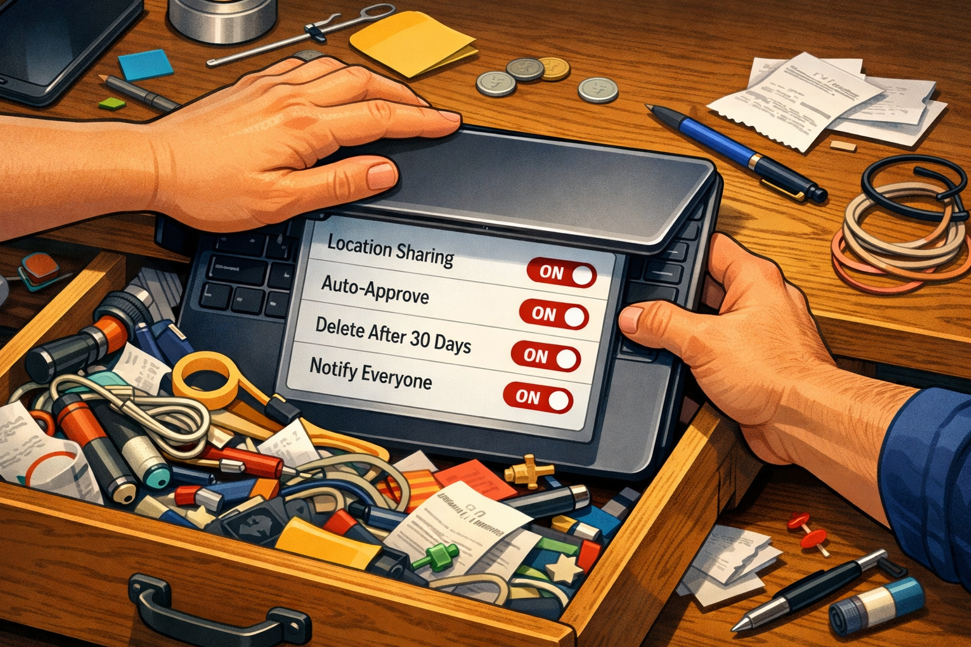
The setting page is like that junk drawer in the kitchen: we only open it at our own peril.
We open it rarely, poke something in it, slam it shut before something gets out. Oh, oops, that’s the junk drawer.
But the same principle applies.
We open the setting page rarely, usually only on setup. We click through a couple of options that we probably don’t know yet whether we’ll need, ignore the rest, and move on with our lives. If and when we go back, something has escaped – er, gone annoyingly, spectacularly wrong.
And yet, that little utility drawer of toggles, permissions, defaults, and preferences is often doing more to shape your daily experience than that polished homepage ever dreamed about doing.
The homepage is the part you see.
The settings page is the boss.
What gets shared.
What gets remembered.
What gets to pop up.
What gets auto-approved.
What gets deleted.
What gets hidden.
What gets assumed.
That’s not configuration.
That’s policy.
And yet, most of us never look at it again.
We Treat Settings Like Housekeeping. They’re Not.
These little toggles and buttons are labelled “setup,” and most people think of them as personalization: notification choices, privacy options, maybe even a dark mode toggle.
But settings pages aren’t really about personal preferences. Not most of the time.
They’re really operating rules.
This is where software decides what “normal” means.
What is automatic? What isn’t?
What is default?
What is shared?
What is flagged, archived, ignored or escalated?
These setting matter because they don’t just change how the software looks, they change how it behaves.
And once those choices are made, they become part of our day-to-day reality, and we never notice it.
Tiny Toggles. Big Consequences.
A toggle is a tiny interface element with a wildly inflated sense of importance.
A setting doesn’t look impressive or important. It’s just a checkbox, a slider, a little toggle, a drop-down hidden three menus deep under some label clearly meant to discourage us from looking for it.
Those tiny little controls frequently decide far far more than we give them credit for.
They can train us to ignore everything because the system can’t tell the difference between urgent and noisy.
That access you allowed six months ago? If you forgot about it, you may still be sharing your location, microphone, or camera data.
In workplace software, it can get even scarier
That default you forgot can auto-close a ticket, auto-assign a ticket to the wrong team, send notification to everyone except the right person, or archive on a fantasy schedule.
And after a while, people stop questioning it, because, “That’s just how the system works.”
That phrase should make all of us a little nervous.
When a Setting Stops Looking Like a Choice
The problem isn’t the settings.
It’s that they disappear. We forget about them. They get lost in that junk drawer.
The software behaves a certain way, and we get used to it. It becomes “normal.” It’s always done it that way.
But a lot of what we call “normal system behaviour” is really the accumulated detritus of all the stuff in the junk drawer: old defaults, forgotten permissions, inherited settings, and the assumptions that nobody has revisited in months or even years, all layered on top of each other.
That’s how small choices take over and become infrastructure.
And infrastructure is really hard to see clearly.
A setting that once looked optional has now become the operating rule.
Default becomes a habit.
Permission becomes assumption.
That forgotten, hidden checkbox is now “the way we do things.”
And convenience has now quietly become policy.
A Better Way to Think About It
We don’t need to spend our weekends spelunking through settings menus like amateur geologists.
But we should stop treating defaults as neutral.
Leaving the default in place is still a decision. It just doesn’t feel like one.
That system doing something annoying, risky, noisy, invasive, or just plain weird? That may not be “just the software.”
It’s probably a choice someone made.
Possibly you.
Possibly the vendor.
Possibly a long-gone sysad.
Whichever it was, it was still a choice, a decision.
The least glamourous part of most software may be the settings page, but it’s also often the heart of the system.
The homepage is the part you see. The settings page is the boss.
And the most powerful part of many products isn’t the homepage.
It’s the page nobody visits after day one.
Jana Diamond
Jana Diamond, PMP, is a Technical Project Manager at Protovate with a career spanning software development and Department of Defense programs. She’s known for bridging technical detail with practical execution—and for asking the questions that keep projects honest. When she’s not working, she’s likely reading science fiction or hunting down her next salt and pepper shaker set.