




“AI” is often just the name we give technology we don’t depend on yet.
I remember when GPS units first started showing up everywhere.
Not maps on a phone.
Not a quiet little voice built into the dashboard.
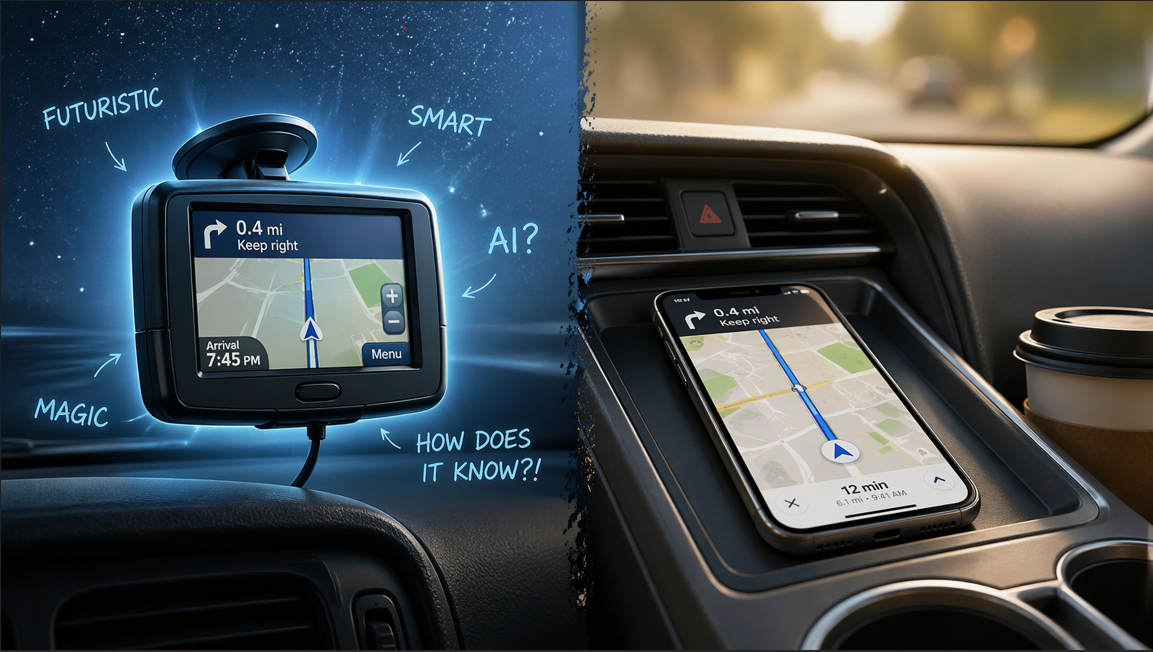
I mean the clunky standalone units stuck to the windshield like plastic barnacles, barking directions in a robotic voice while half the country looked at them like they’d been issued by NASA.
We even named ours, back before Siri and Alexa, after my son’s bossy ex-“girlfiend” Michaela.
Back then, a lot of people called them AI. It drove me batty. People acted like that little windshield brick was thinking, when really it was just sophisticated programming and a whole lot of maps.
It knew where you were.
It knew where you were going.
It recalculated if you missed a turn. Re-calculating . . .
I talked back. Fine, it talked back too.
For a lot of people, that was “AI.”
Nobody says that anymore. Now it’s just GPS. Or Waze. Or some other mapping tool.
And that shift says something useful about how people react to technology.
People don’t react to what technology is. They react to how it’s packaged.
When a system is new, unfamiliar, or a little uncanny, people reach for big labels.
“Smart.”
“Intelligent.”
“AI.”
“Basically magic.”
“HOW in the world does this thing know where I am?”
Once it becomes normal, though, the label changes.
The system didn’t necessarily become less sophisticated.
It just became less surprising.
That’s when “AI” quietly turns into:
- search engines
- spam filters
- autocomplete
- route optimization
- “suggested for you”
- “the app”
Same hat, different horse.
The label tells you more about us than the technology
This is the part people miss.
A lot of the time, “AI” is not a stable technical category in everyday conversation.
It’s a cultural category.
People use it for systems that feel:
- new
- hard to explain
- weirdly capable
- a little intrusive
- a little spooky
- not yet emotionally normalized
Once the same kind of behavior becomes familiar, useful, and boring, we stop calling it AI and start calling it a feature.
That doesn’t mean the underlying system got simpler. It means we got used to it.
The machinery may still be doing ranking, prediction, optimization, or other “smart” work under the hood. We just stopped calling it special.
And once people get used to something, it stops feeling like intelligence and starts feeling like plumbing.
That’s why these arguments get so messy
This is also why so many conversations about AI go off the rails.
People think they’re arguing about a technology category. Half the time, they’re actually arguing about comfort, visibility, trust, control, and whether the system still feels optional.
That’s why someone can say they “hate AI” while using Google search, Maps, spam filters, predictive text, and personalization all day long.
They’re not reacting to the underlying mechanism consistently.
They’re reacting to whether the technology still feels like AI.
The moment it becomes ordinary, the name changes
That’s the pattern.
When a system first shows up doing something that feels almost human, people call it AI.
When it becomes embedded in everyday life, people stop calling it AI and start treating it like electricity.
Invisible.
Expected.
Boring.
Only noticed when it breaks.
That doesn’t mean the technology got simpler.
It means the public moved it from “uncanny” to “infrastructure.”
And that’s usually when the conversation gets less emotional and a whole lot more honest.
Or at least it should.
If you want to understand how people really feel about a technology, don’t just ask whether they “support AI” or “hate AI.”
That label is mushy.
Ask:
- What does the system actually do?
- Is it making decisions, ranking, predicting, recommending, or generating?
- Is it visible or invisible?
- Is it optional or baked in?
- Does it feel helpful, creepy, or controlling?
- Would they still object if it didn’t have the label?
That’s where the truth usually is.
Because most people are not reacting to the mechanism. They’re reacting to the packaging.
And once the packaging stops feeling futuristic, “AI” stops being “AI.”
It becomes infrastructure.
Then a feature.
Then a button.
Then something they swear they’ve never relied on.
Jana Diamond
Jana Diamond, PMP, is a Technical Project Manager at Protovate with a career spanning software development and Department of Defense programs. She’s known for bridging technical detail with practical execution—and for asking the questions that keep projects honest. When she’s not working, she’s likely reading science fiction or hunting down her next salt and pepper shaker set.