




The 10 Laws of Automated Systems
Why software systems become trusted beyond the evidence that supports them
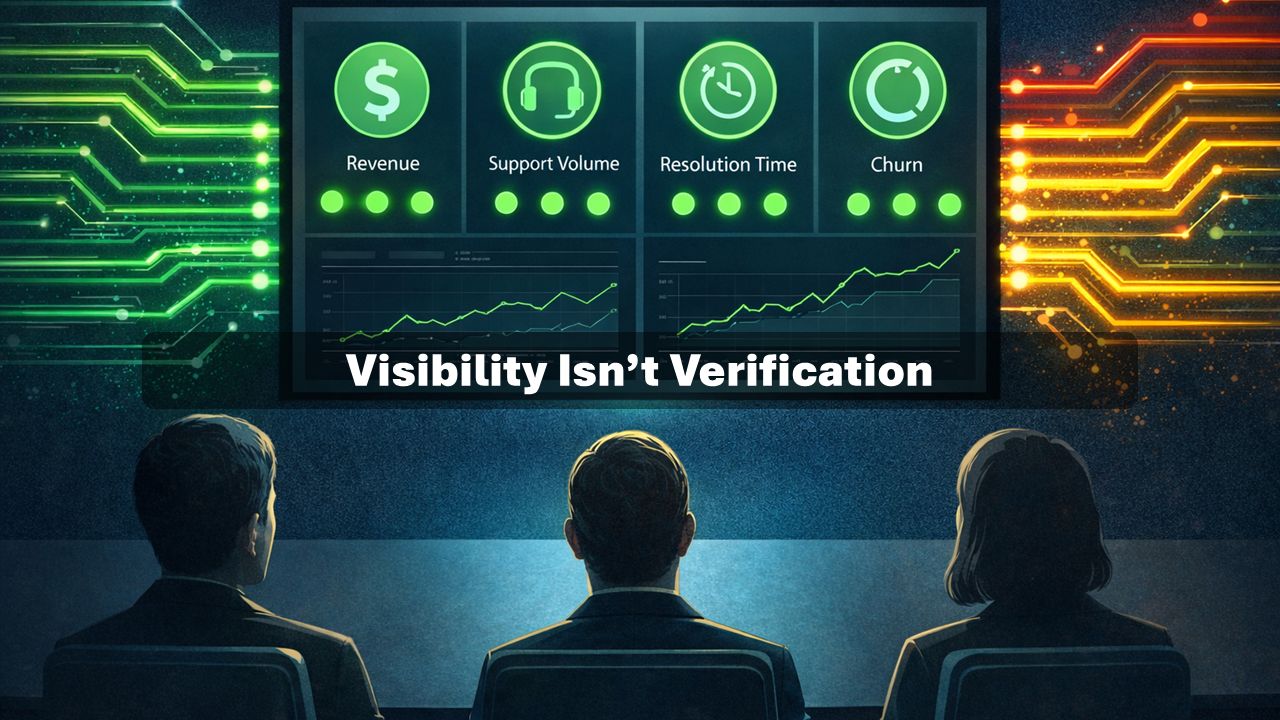
The meeting starts; the dashboard is on the screen. Pretty typical, right?
Metrics running across the top: revenue, support volume, resolution time, churn. All the indicators are green. Trend lines are smooth. Nothing out of place.
Someone says, “Looking good.”
Moving on.
A few minutes later, someone asked a question. One number seemed unusually stable. No change for weeks. Sounds like good news! Stability is, after all, what you want from an operational metric.
But the more we looked at it, the odder it seemed.
Operational data almost never stays that stable. Systems change. Inputs fluctuate. Small anomalies appear. When a metric becomes perfectly stable, that may signal something else is going on.
In this case, something was.
The pipeline feeding the dashboard had stopped updating days earlier.
The dashboard hadn’t failed. It was displaying exactly what it was given. The problem was that nothing new had arrived.
The interface looked authoritative. The system behind it had quietly drifted.
Situations like this appear in modern workplaces, more often than we wish. Not due to poor systems design, and not due to carelessness, but because software changes how trust forms.
Automated systems that work well for long periods gradually become background noise. When that happens, the way people pay attention to them begins to shift.
Over time, certain patterns show up repeatedly in organizations using automated tools. Those patterns are predictable enough that they can be summarized as a small set of rules.
I think of them as the Laws of Automated Systems.
The Laws of Automated Systems
- Automation does not eliminate risk.
It redistributes responsibility. When work moves from people to systems, the risk does not disappear. It shifts into system design, monitoring, governance, and assumptions about how the automation behaves.
- Visibility is not verification.
Dashboards and reports make systems visible. Seeing outputs is not the same as validating the process[es] that produced them.
- Confidence is not evidence.
Systems can produce answers with remarkable certainty. That certainty reflects how the system generates output, not whether it is correct.
- The more reliable a system appears, the less often people question it.
Ironically, success breeds complacency. Systems that perform well over time gradually receive less scrutiny.
- A recommendation everyone follows becomes a decision.
Systems labeled as decision support often become de facto decision-makers once their outputs are rarely challenged.
- Systems shape attention.
Metrics, alerts, rankings, and automated outputs influence where people focus attention and effort; what they notice, and what they ignore.
- People optimize for what the system rewards.
When a system highlights specific metrics or thresholds, people naturally begin optimizing toward those signals. In education, this is called “teaching to the test.”
- If nobody owns the decision, the system owns the outcome.
Responsibility gaps appear when automated outputs are treated as neutral suggestions rather than operational decisions.
- Every automated system accumulates governance debt.
Over time, assumptions drift, data changes, ownership blurs, and oversight weakens unless governance is actively maintained.
- The greatest risk of automation is what people stop noticing.
Automation changes attention. Once a process appears stable, people gradually stop watching it as closely.
The Law Governing All the Others
There is one pattern behind all of these.
Every automated system eventually becomes trusted beyond the evidence that supports it.
Not because people are careless.
Because the system worked yesterday.
And the day before that.
And the day before that.
Success rewires attention. Checks start coming more infrequently. Questions become rare. Assumptions fade into the background.
By the time something goes wrong, the system has already become part of the infrastructure.
And infrastructure is the hardest thing in an organization to see clearly.
These patterns are not unique to AI.
They show up anywhere software influences human decisions: dashboards, automation workflows, analytics systems, reporting tools, and decision support models.
AI simply makes the dynamics easier to notice.
The real challenge is not understanding the technology.
It is understanding how trust forms around the technology.
Once you start looking for these patterns, you see them everywhere.
And when you do, systems stop looking like mysterious black boxes.
They start looking like what they really are:
tools that quietly reshape how people make decisions.
Protovate pioneers new software, new systems, and new ways of working to bring your concept to life. Our hybrid-shore software development outsourcing model gives you access to the ideal talent to make it happen.