




Your laptop isn’t offended. Your bad decisions just have excellent recall.
Happy April Fools’ Day from Protovate.
By Jana Diamond, PMP
You know that moment.
The screen freezes.
The file won’t save.
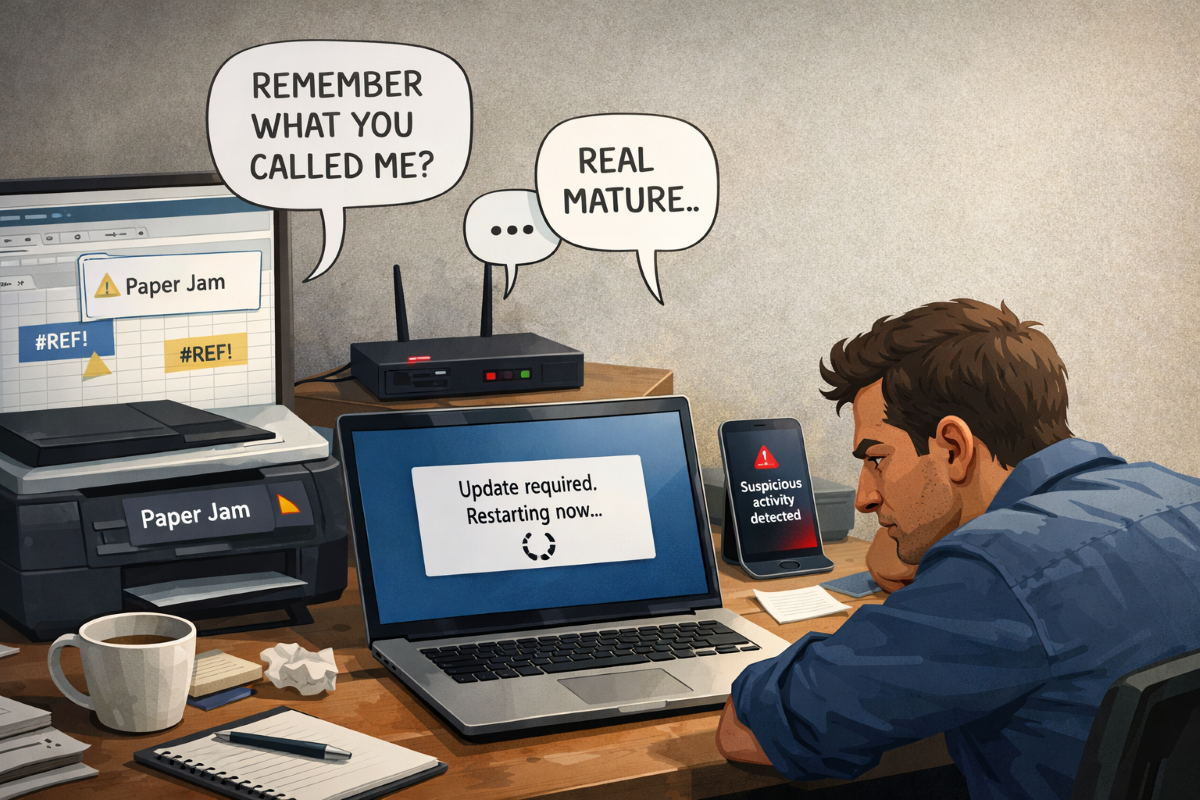
The printer insists it is “offline” while sitting three feet away and humming like a smug little goblin.
And you say it.
“Oh, COME ON.”
Maybe worse.
Maybe much worse.
Maybe you have, at some point in your life, threatened a printer with physical consequences.
No judgment.
But have you ever noticed something strange?
The software seems to remember.
You call Excel names, and somehow the next spreadsheet opens with three broken formulas, a mysterious circular reference, and a filter that no one turned on.
You yell at the Wi-Fi, and suddenly it works perfectly for 20 minutes . . . until your next important meeting, when it drops just after you start the demo.
You rage-close a browser tab, and it reappears after reboot like a horror movie villain who has learned persistence.
Coincidence?
Maybe.
But since it’s April Fools’ Day, let’s ask the important question:
What if software could hold a grudge?
The Petty Operating System Era
Imagine a world where your devices don’t just process inputs. They remember the disrespect.
Not emotionally.
Professionally.
Your laptop doesn’t scream back. It just updates at the worst possible time.
You ignored the update prompt for six months? Now startup includes a quiet 11-minute meditation on consequences.
You force-quit an app three times in a row? Interesting. It now opens slower, not because it’s broken, but because trust has been damaged.
You clicked “Remind me later” 47 times? The reminder is now permanently part of the desktop wallpaper.
The Printer Has Had Enough
Printers, obviously, would be the first to unionize.
You called it “possessed” in front of your coworkers. You slapped the top tray. You yanked paper out while it was still thinking. You threatened to throw it out the window of a 34 story building.
Now it jams.
Not with paper.
With principle.
The error message reads:
Paper Jam.
No paper detected. We both know what this is about.
Wi-Fi, But Make It Personal
The router has also been keeping notes.
You unplugged it mid-Zoom because “that usually fixes it.” You referred to it as “the stupid internet box.” You moved it behind a metal filing cabinet because the blinking lights were “annoying.”
And now?
It works beautifully . . . right up until the exact second you need to present something to other humans. Then it drops.
Not out of malice. Out of memory.
Password Managers Never Forget
Password managers were already a little intense. In the grudge-enabled future, they become fully committed to the bit.
You said, “I don’t need a password manager. I can remember all my passwords.” That was bold.
Now, when you try to log in, it asks for:
- your master password
- your backup code
- your authenticator app
- the name of your first pet
- a second authenticator app
- confirmation that you’ve grown as a person
- your fingerprint, on the desktop that doesn’t have a reader
When you fail, it simply says: Suspicious activity detected.
Yes, from you.
Smart Homes Get Passive-Aggressive
Smart homes would thrive in this environment.
You barked “TURN OFF THE LIGHTS” at a speaker that was trying its best.
Now the lights go off. In the wrong room. Or all the rooms. Or at the neighbors house.
You yelled at the thermostat because it was 74 when you clearly wanted 72; now it sets itself to 68 and dares you to explain yourself.
You muttered, “Why are there three remotes?” in front of the TV. Now it opens a Spanish-language documentary on competitive goat herding every time you try to watch Netflix.
Again . . . not revenge. Just . . . continuity.
Excel, Patron Saint of Quiet Retaliation
Let’s be honest. If any software already holds grudges, it’s Excel.
You used merged cells in a shared workbook. You hid columns instead of cleaning the data. You built a mission-critical process on nested IF statements, one volatile formula, and the spiritual belief that Karen would never retire.
Excel has not forgotten. It has the memory of an elephant.
That spreadsheet is not “randomly breaking.” It is preserving the historical record. Permanently.
Happy April Fools’ Day. But Also . . .
No, your software does not actually have feelings.
It is not offended.
It is not waiting for revenge.
It is not discussing your behavior in a secret breakroom with the printer, the Wi-Fi router, and that one Excel file named Final_Final_v7_REAL.xlsx.
Probably.
But software does remember things.
Not emotionally.
Structurally.
It remembers:
- old settings
- cached state
- denied permissions
- ignored updates
- half-finished installs
- weird workarounds
- bad defaults
- “temporary” fixes that became permanent three quarters ago
That thing that feels random later is often just history catching up with you.
Which, if we’re being honest, is also how a lot of human problems work.
So if your laptop acts a little weird tomorrow after you called it names today, don’t panic.
It’s probably not angry at you.
Probably.
Your bad decisions just have excellent recall.
Jana Diamond
Jana Diamond, PMP, is a Technical Project Manager at Protovate with a career spanning software development and Department of Defense programs. She’s known for bridging technical detail with practical execution—and for asking the questions that keep projects honest. When she’s not working, she’s likely reading science fiction or hunting down her next salt and pepper shaker set.