





Modern websites aren’t just being read anymore. They’re being interpreted.
I started noticing something strange while rebuilding my personal site, GIA.net.
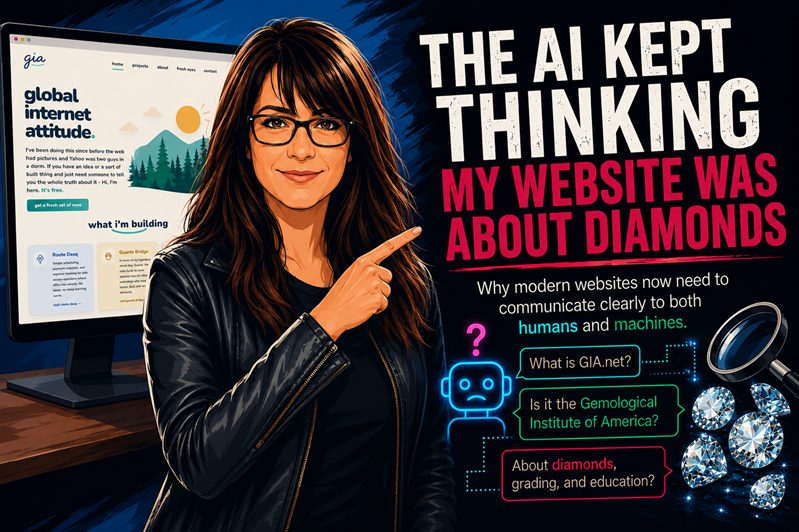
Humans understood the site almost immediately. AI systems kept seeing old information, missing context, or misunderstanding what the site actually was. In my case, they kept confusing me with the famous diamond people.
That sent me down a rabbit hole. Modern websites aren’t just being read by people anymore. They’re being interpreted by AI systems, search engines, summaries, assistants, and crawlers that all process information differently.
For years, most of us built websites primarily for humans.
Make it look good.
Make it load quickly.
Make it rank in search.
Make it easy to navigate.
Perfectly fine.
But now there’s another audience quietly sitting at the table: machines trying to explain your site to other humans.
And they do not experience your website the way people do.
They aren’t impressed by beautiful animations or clever branding. They don’t “get the vibe.” They’re trying to reconstruct meaning from structure, metadata, text relationships, headings, links, and consistency signals.
Which means something important has changed:
Clarity now matters twice.
Once for humans.
Once for machines.
And those are not always the same thing.
What AI Actually Sees
AI systems don’t browse websites the way humans do. They parse them.
That sounds like a tiny distinction. It isn’t.
Humans absorb context naturally:
- visual hierarchy
- design cues
- tone
- imagery
- layout
- reputation
- prior knowledge
Machines don’t.
A person landing on GIA.net could immediately tell what the site was about. The AI systems? Not so much. Some kept associating it with the Gemological Institute of America because that identity already existed heavily across the web.
To a machine, ambiguity is sticky.
And the modern web is full of ambiguity.
A surprising number of websites are:
- visually polished
- structurally messy
- semantically vague
- loaded with contradictory messaging
- dependent on JavaScript rendering
- packed with AI-generated filler text that says a whole lot of nothing
Looks spiffy to humans.
Absolute cowboy math for interpretation systems.
The Weird New Layer of the Internet
Search engines have always interpreted websites to some degree. That part isn’t new.
What’s changing is that AI systems increasingly generate summaries for users instead of simply sending users to the source material.
That’s a different relationship.
A traditional search engine might rank your page incorrectly.
An AI assistant might confidently explain your business incorrectly.
Those are not the same failure modes.
And honestly, that’s the part I think many people are underestimating right now.
Because discoverability is quietly becoming an interpretation problem.
The weird part isn’t that AI systems read websites now.
Search engines have been doing that for years.
The weird part is that machines are starting to explain your business before humans ever see it for themselves.
Which means clarity is no longer just a branding problem.
It’s becoming an interpretation problem.
What I Changed
While rebuilding GIA.net, I started experimenting with ways to make the site easier for AI systems to interpret correctly.
Not manipulate.
Not “hack.”
Not trick.
Just clarify.
I added:
- llms.txt
- markdown-based summaries
- structured crawler guidance
- cleaner semantic HTML
- tighter identity consistency
- sitemap improvements
- machine-readable context layers
None of this is magical.
That’s the funny part.
There’s no secret AI wand here. No mystical optimization sauce. Most of it boils down to making the site easier to understand structurally and reducing ambiguity wherever possible.
The proof’s in the pudding:
once the signals became cleaner, the misunderstandings started dropping.
And Here’s the Really Interesting Part
I didn’t hand-code most of this.
Back in the old days, I was editing Pico files directly on the server like some kind of caffeinated goblin living inside a terminal window. Different era.
This time, I actually used AI to help generate and refine parts of the discovery layer itself:
- summaries
- markdown structures
- organization ideas
- interpretation patterns
- crawler-facing documentation
Which creates a slightly hilarious loop when you think about it.
Using AI to help machines understand a website more accurately.
Very “AI wearing a cowboy hat indoors.”
But it worked.
Not because AI magically understood the site.
Because the process forced clearer structure and clearer explanations.
That’s the real shift happening here.
Why This Matters
People still think websites are mostly digital brochures for humans.
Increasingly, they’re becoming machine-readable identity systems.
And machines are starting to explain businesses, projects, products, and people before humans ever see the original source for themselves.
That means clarity is no longer just branding.
It’s interpretation.
And if the machines misunderstand what your site is, what you do, or who you are . . . there’s a decent chance users will inherit that misunderstanding too.
Not because the AI is evil.
Not because the system is sentient.
Just because ambiguity fills itself in.
The internet used to be mostly about being found.
Now it’s also about being understood.

Laura Giacoppo
Laura describes her role as the “answerer of all the questions, doer of things.” She fosters our strong team culture and prizes the growth she sees in our talented, global crew.
When she’s not working, and sometimes when she is, you can find her (maybe) somewhere exploring something in the Pacific Northwest.