



Now We Trust Machines With Our Identities And Never Think About It Twice
I’m old enough to remember when people thought ATM machines were a terrible idea.
Not “mildly concerning.”
Not “maybe I’ll wait a bit before trying it.”
I mean genuinely unsettling. Scary.
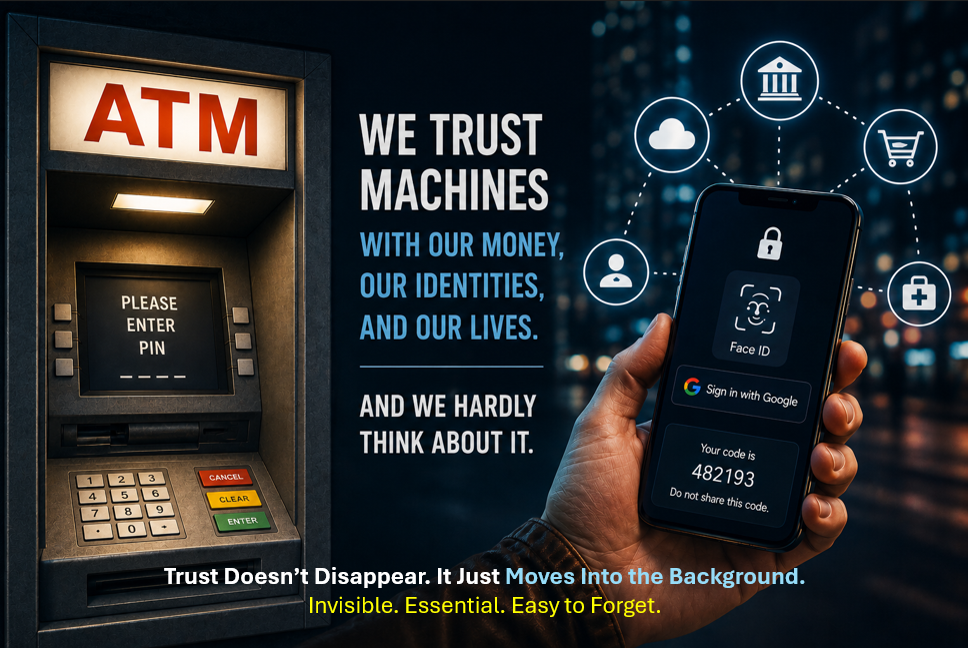
You were supposed to put your bank card into a machine sitting in the wall of a building, type in a secret number, and trust that some invisible computer system correctly understood:
- who you were
- how much money you had
- whether you were allowed to access it
And then . . . voilà! Cash appeared.
Honestly, if you described that concept cold to someone in 1965, it would sound like science fiction.
People worried the machine would eat their card. Or dispense the wrong amount. Or lose track of the transaction entirely. Some people didn’t trust computers handling financial records at all. Others hated the idea of removing humans from banking. A machine couldn’t “understand” a mistake, after all.
And the funny part?
Those concerns weren’t irrational.
At the time, trusting a machine with your money was a massive psychological leap.
Now?
We shove debit cards into gas pumps in the rain while half-paying attention to a podcast and wondering whether we remembered to thaw the chicken.
That shift happened so gradually we barely noticed it.
The Technology Stopped Feeling Like Technology
The ATM normalized something much bigger than automated banking.
It normalized the idea that machines could act as trusted intermediaries between us and important parts of our lives.
First it was cash.
Then credit cards online.
Then direct deposit.
Then online banking.
Then mobile payments.
Then storing payment information in browsers.
Then tapping phones against terminals like we’re auditioning for Star Trek.
Somewhere along the way, the technology stopped feeling like technology and started feeling like infrastructure.
That’s the interesting part.
Most of us don’t think of an ATM as a computer system making decisions about authentication, account validation, transaction processing, fraud detection, network communication, and ledger reconciliation in real time.
It’s just . . . the ATM.
In our family, we call them “Anty-M.”
The same thing happened to GPS. At first, dashboard navigation systems felt futuristic and vaguely suspicious. Now people follow phone directions straight into lakes often enough that it has become its own genre of news story.
Not because humans got dumber.
Because repeated success rewires trust.
Once a system works often enough, the brain stops evaluating the mechanism and starts assuming the outcome.
That’s efficient most of the time.
But . . . but . . . there’s a catch.
The Trust Became Invisible
Today, we trust machines with things far more personal than cash.
Our identities.
Think about how many systems currently act as proof that you are . . . you.
Your phone unlocks with your face.
Your bank trusts a six-digit code texted to a device in your pocket.
Websites let you “Sign in with Google” as if Google has quietly become a passport office for the internet.
A password reset email can unlock:
- banking
- healthcare
- tax records
- work systems
- cloud storage
- private conversations
- years of personal history
And most of us treat this as perfectly fine because the trust relationship has been normalized.
We stopped experiencing these systems as negotiations with technology and started experiencing them as ordinary life.
That changes how people think about risk.
Early ATM users actively evaluated the system every time they used it:
“Will this work?”
“Can I trust it?”
“What happens if it fails?”
Modern infrastructure rarely gets that level of scrutiny anymore.
Until something breaks.
Then suddenly everyone remembers there’s an enormous amount of machinery behind the curtain:
authentication systems
identity providers
payment processors
fraud engines
databases
Complicated systems do not fail loudly. They fail quietly and repeatedly.
And once technology becomes infrastructure, failures stop feeling like technology problems.
They feel personal.
The strange thing is that trust usually doesn’t arrive with a dramatic announcement.
It arrives through repetition:
A few successful transactions.
A refund when something goes wrong.
A fraud alert that actually works.
A support system that catches failures before they become disasters.
Over time, the system starts feeling less like a risk and more like plumbing.
That’s how infrastructure works.
Nobody stands in the kitchen marveling at indoor plumbing anymore. We just expect water to appear when we turn the handle. The complexity disappears behind the wall.
Background Machinery
Most of us can’t explain:
- how card networks route transactions
- how identity providers authenticate users
- how biometric matching functions
- how password recovery chains operate
And honestly, we don’t need to.
That abstraction is part of what makes large systems usable at scale in the first place.
But abstraction has an odd side effect:
the machinery becomes emotionally invisible.
Once that happens, we stop asking:
“How does this system work?”
And start asking:
“Why would I even think about it?”
That’s a very different kind of trust.
Not active trust.
Assumed trust.
The ATM didn’t just teach society that machines could handle money.
It helped teach us something much larger:
if a system works smoothly enough for long enough, humans eventually stop experiencing it as technology at all.
The Catch
The problem isn’t that these systems are inherently bad.
Most of the time, they work remarkably well.
The problem is that invisible trust changes human behavior.
Once a system becomes ordinary enough, people stop treating it like a negotiated risk and start treating it like part of reality itself.
That’s why outages feel so disorienting now.
When banking systems go down, people can’t buy groceries.
When identity providers fail, workers can’t log into their jobs.
When authentication systems break, people suddenly lose access to huge portions of their lives all at once.
Not because the technology became malicious.
Because infrastructure failure hits differently once trust becomes invisible.
Now machines mediate identity, access, communication, memory, and increasingly, daily life itself.
And most of the time, we barely notice the negotiation happening anymore.
The ATM didn’t just teach us to trust machines with money.
It taught us how easily trust disappears into the background.
The most powerful technologies are not the ones people fear.
They’re the ones people stop noticing.
Jana Diamond
Jana Diamond, PMP, is a Technical Project Manager at Protovate with a career spanning software development and Department of Defense programs. She’s known for bridging technical detail with practical execution—and for asking the questions that keep projects honest. When she’s not working, she’s likely reading science fiction or hunting down her next salt and pepper shaker set.